
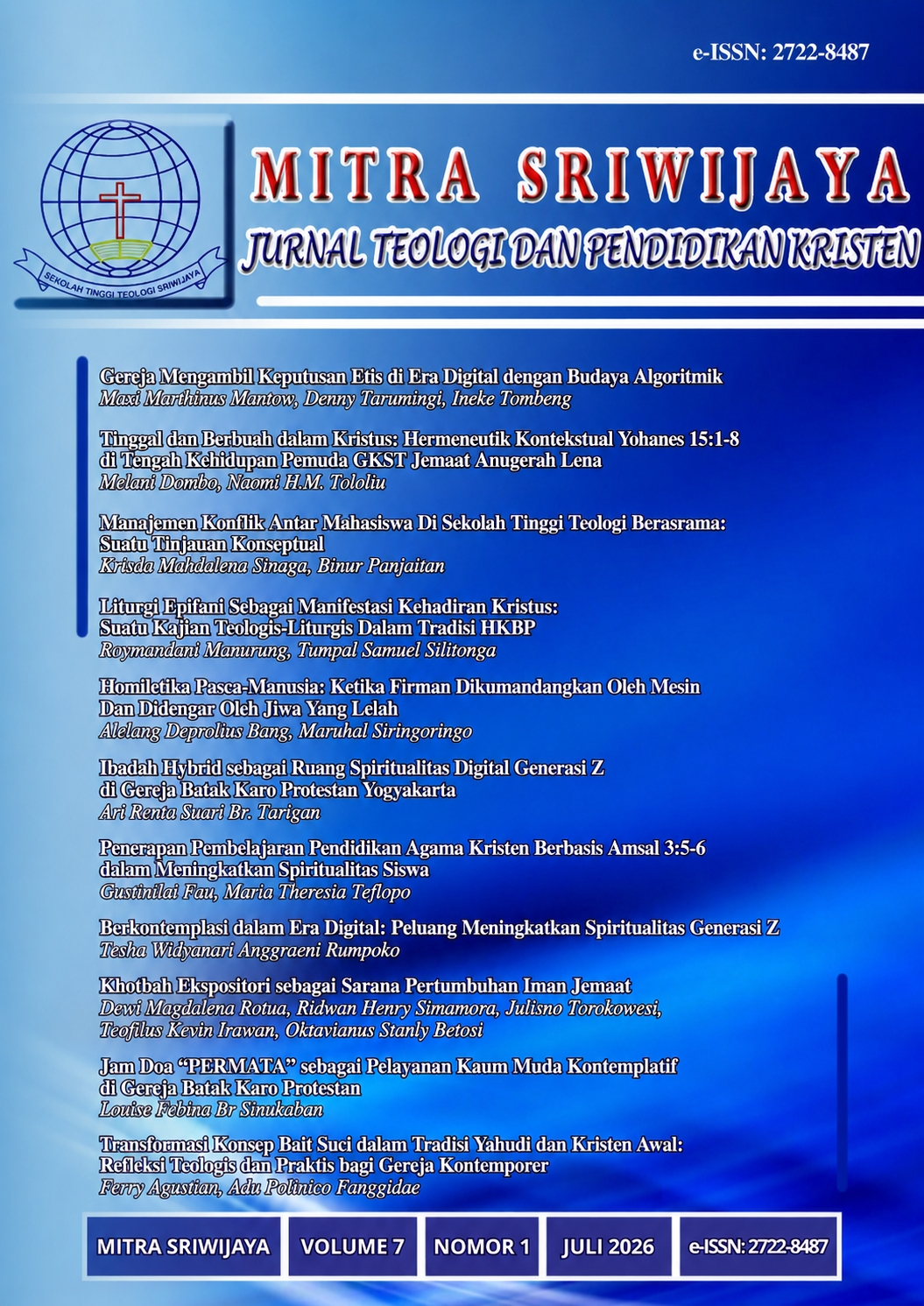
Gereja Mengambil Keputusan Etis di Era Digital dengan Budaya Algoritmik
Article Sidebar
Main Article Content
Abstract
The emergence of digital and algorithmic culture has significantly transformed ethical decision-making within the church in contemporary society. This article examines ecclesial ethical discernment through Paul Tillich’s method of correlation in the context of the Gereja Masehi Injili di Minahasa (GMIM). Using a constructive theological approach, the study argues that algorithmic culture is not merely a technological framework but an existential condition shaping ecclesial authority, moral perception, and theological reflection. The church exists within tensions between empirical digital realities (das Sein) and normative Christian ideals (das Sollen). Algorithmic logic characterized by virality, visibility, and engagement increasingly influences ethical judgments and creates new forms of moral ambiguity within church life. This article proposes the Digital Ecclesial Ethical Discernment (DEED) model as a framework integrating existential digital challenges with Christian ethical norms such as agape, veritas, dikaiosyne, responsibility, and imago Dei. The model offers a structured and contextual approach for ecclesial ethical decision-making within contemporary digital transformation.
Article Details

This work is licensed under a Creative Commons Attribution-ShareAlike 4.0 International License.
References
Airoldi, M., & Rokka, J. (2022). Algorithmic consumer culture. Consumption Markets & Culture, 25(5), 411–428.
Amarkwei, C. (2020). Paul Tillich and his system of paradoxical correlation: forging a new way for science and theology relations. Wipf and Stock Publishers.
Atuahene, J. O. (2022). A practical theological exploration into the Methodist Church Ghana’s use of social media. Unpublished Manuscript]. South African Theological Seminary.
Bingaman, K. A. (2023). Religion in the digital age: An irreversible process. Religions, 14(1), 108.
Bîrzu, V., & Madina, A.-M. (2026). Algorithmic Conditioning and Divine Indwelling: Towards a Theological Anthropology of Education in the Age of Artificial Intelligence. Religions, 17(6), 708. https://doi.org/10.3390/rel17060708
Bonhoeffer, D., & Smith, N. H. (1995). Ethics. Touchstone.
Boos, A. K. (2024). Conceptualizing automated decision-making in organizational contexts. Philosophy & Technology, 37(3), 92.
Brady, W. J., Jackson, J. C., Lindström, B., & Crockett, M. J. (2023). Algorithm-mediated social learning in online social networks. Trends in Cognitive Sciences, 27(10), 947–960.
Campbell, H. (2010). When Religion Meets New Media (1st Editio). Routledge.
Campbell, H. (2020). Digital Creatives and the Rethinking of Religious Authority. In Media, Religion and Culture (pp. 34–39). Routledge.
Campbell, H. A. (2013). Digital Religion: Understanding Religious Practice in New Media Worlds. Routledge.
Casanova, J. (2008). Public Religions in the Modern World. University of Chicago Press.
Castells, M. (2015). Networks of Outrage and Hope: Social Movements in the Internet Age (2nd Revise). Polity Press.
Cooper, R. D. (1975). Carotenoids and Related Compounds. Part XXXII. Synthesis of Astaxanthin, Phoenicoxanthin, Hydroxyechinenone, and the Corresponding Diosphenols. Journal of the Chemical Society, Perkin Transactions 1, 21, 8.
Cornelio-Arias, M. (2026). Incarnational presence as prophetic resistance: A missiological critique of digital church in the algorithmic age. Missiology, 00918296261450198.
Debataraja, M. R. (2025). Teologi Kristen di Era Disrupsi: Menjawab Tantangan Iman di Tengah Perubahan Global. Yayasan Yuta Pendidikan Cerdas.
Elizabeth, E., & Mikaere, G. (2025). Christian Service Ethics in Facing the Challenges of the Digital World: A Theological-Ethical Perspective on Digital Engagement. Ministries and Theology, 2(2), 55–64.
Emerton, D. (2020). God’s Church-community: The Ecclesiology of Dietrich Bonhoeffer. Bloomsbury Publishing.
Gillespie, T. (2018). Custodians of the Internet: Platforms, Content Moderation, and the Hidden Decisions That Shape Social Media. Yale University Press. https://doi.org/10.12987/9780300235029
Han, B.-C., & Butler, E. (2017). In the Swarm: Digital Prospects. MIT Press.
Hauerwas, S. (2013). A Community of Character: Toward a Constructive Christian Social Ethic. University of Notre Dame Press.
Hutagalung, A., & Marbun, R. C. (2025). Transformasi gereja di era digital: Kajian teologis pra dan pasca internet. Pengharapan: Jurnal Pendidikan Dan Pemuridan Kristen Dan Katolik, 2(2), 83–95.
Ibrani, A. J. (2025). Etika Kristen dalam Menghadapi Krisis Moral Generasi Muda di Era Digital. Coram Mundo: Jurnal Teologi Dan Pendidikan Agama Kristen, 7(2), 43–59.
Jimmy, A. (2025). Pastoral Digital Dalam Era Disrupsi Teknologi: Transformasi Pelayanan Gereja Katolik Menghadapi Tantangan Dan Peluang Evangelisasi Virtual. Jurnal Reinha, 16(1), 63–76.
Kolkman, D., & van Maanen, G. (2025). Algorithmic models through a representational lens. The Information Society, 41(1), 33–50.
Lagerkvist, A., Tudor, M., Smolicki, J., Ess, C. M., Eriksson Lundström, J., & Rogg, M. (2024). Body stakes: an existential ethics of care in living with biometrics and AI. AI & SOCIETY, 39(1), 169–181.
Metzler, H., & Garcia, D. (2024). Social drivers and algorithmic mechanisms on digital media. Perspectives on Psychological Science, 19(5), 735–748.
Naufal, M. (2025). Etika Algoritma Rekomendasi Media Dan Polarisasi. Communicator Sphere, 5(2), 72–82.
Ndereba, K. M. (2023). Digital ecclesiology and Africa’s digital natives: prospects and challenges. Acta Theologica, 43(1), 98–111.
Ndiaye, A. (2023). Social Media, Christianity, and Gen-Z: The Rise and Influence of Social Media and How Church Leaders Should Engage With It. 5 Kevin Ung, Director of McNair Scholar’s Program, 327.
Ndruru, S. (2025). Pendidikan Agama Kristen Di Era Skeptisisme Digital: Rekonstruksi Pedagogi Iman Berdasarkan Teologi Kontekstual Timothy Keller. Regula Fidei: Jurnal Pendidikan Agama Kristen, 10(2), 327–350.
Packiam, G. (2022). The resilient pastor: Leading your church in a rapidly changing world. Baker Books.
Papakostas, C. (2025a). Artificial Intelligence in Religious Education: Ethical, Pedagogical, and Theological Perspectives. Religions, 16(5), 563.
Papakostas, C. (2025b). Mediating the Sacred in the Digital Age: Computational Approaches to Religious Practice, Ethics, and Discourse. Novel & Intelligent Digital Systems Conferences, 237–250.
Pohagi, D., & Sutrisno, R. D. (2025). Gereja Virtual dan Komunitas Digital: Transformasi Iman dalam Ekosistem Media Sosial. Jurnal Ilmu Pendidikan Keagamaan Kristen: Arastamar, 1(4), 80–100.
Ridha, N. A. N., Andriyani, W., Kurniawan, E., Afriyanti, L., Maipauw, M. M., Amri, S. R., Wijayati, I. W., Arsyad, A. A. J., Nugroho, F. A., Nugrahani, A. G., & others. (2025). Masyarakat Digital Dan Kebebasan Berpendapat: Integrasi Perspektif Hukum, Etika, Dan Literasi Teknologi. Penerbit Widina.
Rif’an, A., & Somantri, E. (2024). Algoritma Opini Publik: Perspektif Sejarah dan Transformasi Digital. IRCiSoD.
Saputra, Y., Lamuji, Y., Ebandro, E., Hipir, S. O. R., & Yuswanto, F. (2025). Katekese Kontekstual sebagai Respons Pastoral terhadap Tantangan Budaya Populer dalam Pendidikan Iman Anak dan Remaja Katolik. Jurnal Filsafat Dan Teologi Katolik, 9(1), 60–75.
Stott, J. (2006). Issues Facing Christians Today. Zondervan.
Subagyo, A. B. (2020). Pengantar Riset Kuantitatif Dan Kualitatif: Termasuk Riset Teologi Dan Keagamaan. Yayasan Kalm Hidup.
Tillich, P. (1959). Theology of culture (Vol. 124). Oxford University Press.
Tillich, P. (1973). Systematic Theology. In Volume 1: Reason and Revelation, Being and God. University of Chicago Press.
Tillich, P. (2009). Dynamics of Faith. HarperCollins Publishers.
Tillich, P. (2011). Systematic Theology: Life and the Spirit History and the Kingdom of God. University of Chicago Press.
Tracy, D. (1990). Dialogue with the other: The inter-religious dialogue (Vol. 1). Peeters Publishers.
Vossenkuhl, W. (2021). Geltung zwischen Sein und Sollen: Über einige Wandlungen des Geltungsproblems. In Sein und Sollen (pp. 9–36). Brill mentis.
Winter, D. (2026). Religious Ethics in the Age of AI: A Comparative Study of Faith-Based Approaches to AI Governance. AI and Ethics, 6, 298. https://doi.org/10.1007/s43681-026-01156-6
Young Theodore, P. S. (2022). Ignatian Spiritual Conversation and Digital Communication Culture.
Zhu, C., Io, M.-U., Ngan, H. F. B., & Peralta, R. L. (2024). Interpreting the impact of augmented reality on heritage tourism: two empirical studies from World Heritage sites. Current Issues in Tourism, 27(23), 4374–4388.